
Plan a Seven Sisters day trip from London without a car, following our scenic coastal walk from Seven Sisters Country Park to Birling Gap, with practical transport, hiking and safety tips.
- Seven Sisters Day Trip from London at a Glance
- Is Seven Sisters a Good Day Trip from London?
- What Are the Seven Sisters?
- How to Get to Seven Sisters from London
- Our Seven Sisters Day Trip Itinerary
- 1. Pick Up Picnic Supplies in Eastbourne
- 2. Start at Seven Sisters Country Park Visitor Centre
- 3. Follow the Cuckmere Valley Towards the Beach
- 4. Climb Haven Brow
- 5. Slow Down for a Picnic Above the Coast
- 6. Walk Across the Seven Chalk Hills
- 7. Expect Wind, Sun and Very Little Shade
- 8. Finish the Walk at Birling Gap
- 9. Return to Eastbourne by Bus
- How Difficult Is the Seven Sisters Walk?
- Seven Sisters Cliff Safety
- What to Bring for a Seven Sisters Day Trip
- Can You Walk the Full Route from Seaford to Eastbourne?
- FAQs About Visiting Seven Sisters from London
- Final Thoughts on Our Seven Sisters Day Trip
A Seven Sisters day trip from London is a simple way to leave the city behind for a few hours and spend the day walking beside one of England’s most recognisable stretches of coastline.
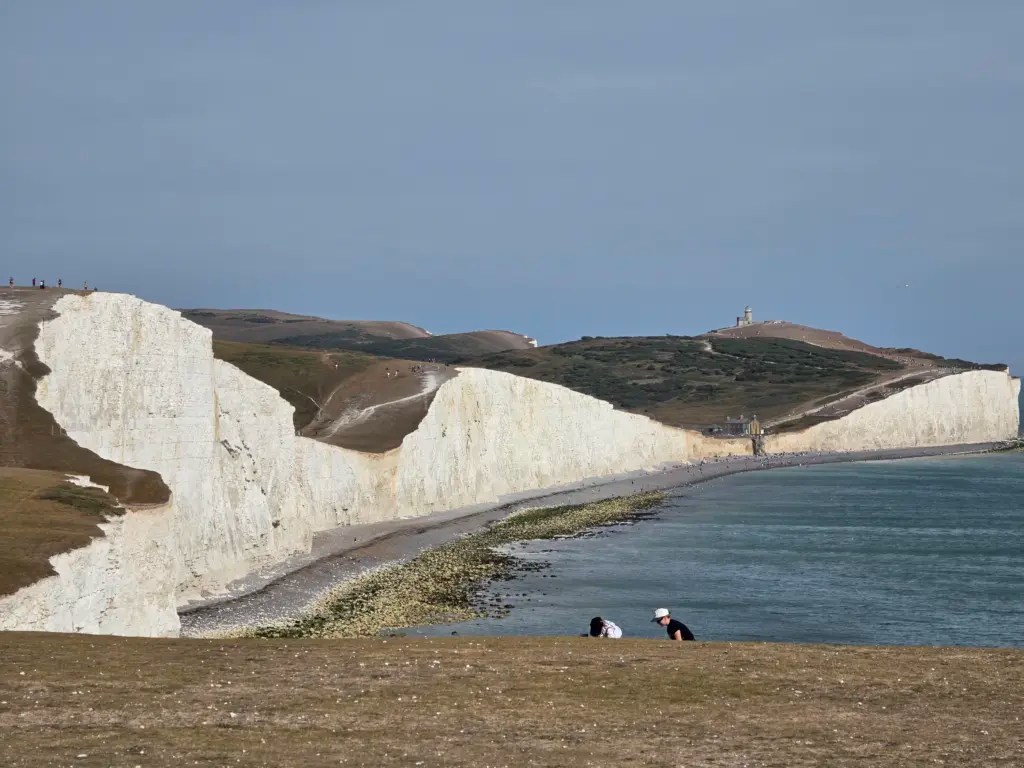
Many people associate Seven Sisters with the full coastal hike between Seaford and Eastbourne. That is a rewarding route, but it requires most of the day and a reasonable level of stamina. We chose a shorter version, starting at Seven Sisters Country Park and finishing at Birling Gap.
This still allowed us to walk over the chalk hills, stop for a long picnic and enjoy the coastline without treating the day as an endurance challenge. Apart from the first climb, we took things slowly, pausing on each hill rather than pushing towards the finish.
Seven Sisters Day Trip from London at a Glance

Starting point: Seven Sisters Country Park Visitor Centre
Finishing point: Birling Gap
Nearest useful stations: Eastbourne, Seaford and Brighton
Walking distance: Approximately 3 miles or 4.8 kilometres
Walking time: Around 1½–3 hours without long stops
Our approach: Train to Eastbourne, bus to the visitor centre, walk to Birling Gap and return by bus
Difficulty: Moderate, with several short but steep climbs
Facilities: Toilets and refreshments at the visitor centre and Birling Gap
Best suited to: Travellers comfortable with hills, uneven ground and exposed coastal paths

The National Trust classifies the route between Birling Gap and Seven Sisters Country Park as moderate. Although the distance is not especially long, the repeated climbs make it feel more demanding than a flat three-mile walk. The official route information allows between 1½ and three hours, although we needed longer because of our picnic and photography stops.
Is Seven Sisters a Good Day Trip from London?

Seven Sisters works well as a day trip from London because you can reach the area by train and bus without hiring a car. An early start gives you enough time to walk a shorter section of the coastline, have a picnic and return to London in the evening.
The journey requires more planning than a town-based day trip because there is no railway station directly beside the cliffs. However, the connections through Eastbourne, Seaford and Brighton make the park fairly accessible by public transport.
It is also an easy trip to adapt. Strong walkers can continue towards Beachy Head and Eastbourne, while those looking for a slower day can walk only as far as Birling Gap, as we did.
What Are the Seven Sisters?

The Seven Sisters are a sequence of chalk hills and cliffs along the East Sussex coast, between the River Cuckmere near Seaford and Birling Gap towards Eastbourne.
The country park covers around 280 hectares of chalk grassland, river valley and coastline. The River Cuckmere runs through the park before reaching the sea at Cuckmere Haven, creating the winding river landscape often seen in photographs of the area.

The seven traditional hills are:
- Haven Brow
- Short Brow
- Rough Brow
- Brass Point
- Flagstaff Point
- Flat Hill
- Baily’s Hill
Depending on the direction you walk, Haven Brow will either be the first or last of the Seven Sisters. Starting from Seven Sisters Country Park meant it was the first significant climb of our route.
The coastline forms part of the South Downs National Park and the Sussex Heritage Coast. Sheep continue to graze on the grassland, so parts of the walk feel more like open farmland than a conventional visitor attraction.

How to Get to Seven Sisters from London
There are two practical approaches when travelling from London: arrive through Eastbourne from the east or through Seaford or Brighton from the west.
Travelling from London to Eastbourne
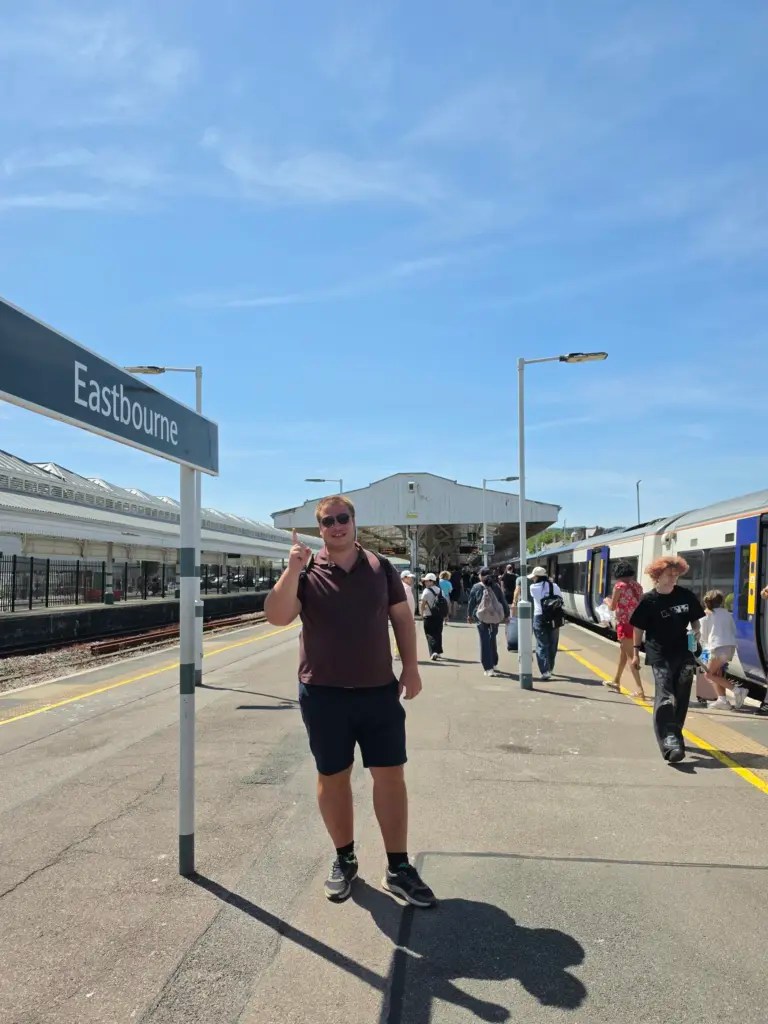
We travelled from Farringdon because it was convenient for us, although London Victoria, London Bridge and Blackfriars can also be useful departure points depending on the train service and where you are staying.
Check the journey carefully before leaving, as some routes require a change. London Victoria is often the most straightforward station for Eastbourne, while Farringdon, Blackfriars and London Bridge have useful Thameslink connections towards Brighton.
We chose Eastbourne because it gave us an easy place to buy picnic supplies before catching the bus to the country park. It also meant that, after finishing at Birling Gap, we could return in the same direction rather than continuing the full walk into Eastbourne.
Travelling Through Seaford or Brighton

Seaford is geographically closer to Seven Sisters Country Park and is a practical alternative for this particular route. Trains from London may require a change at Lewes.
Brighton has more frequent rail connections from London, but it is farther from the park. From Brighton, you still need to take a coastal bus through Seaford towards Seven Sisters.
Whichever station you choose, check the latest journey times through National Rail before travelling.
Taking the Bus to Seven Sisters Country Park

The official country park guidance currently recommends the 12, 12A and 12X Coaster services, which run between Brighton, Seaford and Eastbourne. All three stop outside Seven Sisters Country Park Visitor Centre.
From Eastbourne, the journey takes roughly 20 minutes, depending on the service and traffic.
The bus journey was already part of the experience for us. As we left Eastbourne, the streets gradually gave way to open grassland and coastal views. It is worth sitting beside a window and keeping your camera accessible rather than buried at the bottom of your bag.
Join an Organised Trip to Seven Sisters from London
If you prefer to join an organised trip from London to Seven Sisters, please see our recommendations below:
Our Seven Sisters Day Trip Itinerary
1. Pick Up Picnic Supplies in Eastbourne

We bought food in Eastbourne before boarding the bus. There are refreshments at the visitor centre and a National Trust café at Birling Gap, but carrying our own lunch meant we could stop wherever the view felt right.
There are very few places to buy anything once you are walking across the cliffs. Bringing enough water is particularly important on a warm day, as the route is exposed and there is almost no shade.
2. Start at Seven Sisters Country Park Visitor Centre

We got off the bus at Seven Sisters Country Park Visitor Centre, beside the A259 at Exceat.
The visitor centre is a useful place to check the route, use the toilets and confirm the latest path conditions before setting out. From here, a path follows the Cuckmere Valley towards the coast.
The first part of the walk feels gentle compared with what comes later. The route runs beside open grassland and the River Cuckmere, with the chalk cliffs gradually becoming more prominent ahead.
3. Follow the Cuckmere Valley Towards the Beach

From the visitor centre, we walked towards Cuckmere Haven and the pebble beach.
This section gives you a different perspective from the cliff-top route. Rather than looking down from above, you approach the coastline at ground level, with the white chalk hills rising in front of you.
The landscape is open and fairly exposed. There are no wooded sections, tall buildings or much shelter from the sun and wind. That openness is part of the appeal, but it also makes the weather more noticeable.
Near the river mouth, follow local warning signs and do not attempt to cross fast-moving water. The South Downs National Park Authority has warned that currents around the mouth of the Cuckmere can be dangerous.
4. Climb Haven Brow

Haven Brow was the first major climb of our walk and probably the most intense part of the day.
We took a direct route through part of the farmland. In hindsight, this was not our most sensible decision. The gradient was steep, and the climb felt much harder than it had appeared from below.
A gentler path may take slightly longer, but we would choose it next time rather than tackling the hill directly. The chalk, grass and loose gravel can also become slippery, particularly after rain.
Reaching the top changed the atmosphere of the walk. The river valley opened behind us, while the coastline began to unfold towards Birling Gap.
5. Slow Down for a Picnic Above the Coast

Rather than immediately continuing, we found a place to sit and opened the supplies we had brought from Eastbourne.
This became one of our favourite parts of the day. There was no need to rush, and after the climb it felt good simply to sit in the grass and watch the changing light across the water.

The coastline here shares the same white-chalk character as other parts of southern England. You can see a different version of it during a day trip to the White Cliffs of Dover, where the cliffs are closely tied to the port and Britain’s maritime history.
Farther west, the chalk landscape appears again around the Needles on the Isle of Wight, although there it has been eroded into narrow stacks stretching into the sea.
Seven Sisters feels different because of the repeated rise and fall of the hills. From one summit, you can look back across the folds of the coastline before descending and climbing again.
6. Walk Across the Seven Chalk Hills

After lunch, we continued across the hills towards Birling Gap.
The route is not technically difficult, but it is constantly undulating. Each descent is followed by another climb, so it is better to settle into a steady pace rather than trying to move quickly.
We stopped regularly on the hilltops. Some gave us broad views across the English Channel, while others looked inland across sheep fields and open downland.

This remains working grazing land, and sheep can often be seen near the path. Give livestock space, keep dogs under close control and make sure gates are left as you find them.

There are also occasional memorial stones along the route. On Flagstaff Point, the William Charles Campbell Monument commemorates the donation that helped the Seven Sisters Preservation Fund purchase Crowlink Valley for public use during the 1920s.
The monument provided another natural place to stop. After several climbs, we were quite happy to sit for a moment and take in the view rather than immediately moving on.
7. Expect Wind, Sun and Very Little Shade

We found the cliffs fairly windy, although on that particular day it helped cool us down after the climbs.
The wind can feel very different on the exposed hilltops compared with the sheltered valleys. Even on a warm day, carrying a light windproof layer is sensible.

There are no trees along most of the route, so there is little protection from the sun. Sunscreen, a hat and enough drinking water matter more here than the relatively short distance might suggest.
Weather can also change quickly beside the coast. A bright morning in Eastbourne does not necessarily guarantee calm conditions on the cliffs.
8. Finish the Walk at Birling Gap

Birling Gap made a practical finishing point for our shorter Seven Sisters walk.
The National Trust site has a café, shop and toilets, which felt particularly welcome after several hours on the exposed coastline. Opening hours vary through the year, so it is sensible to check the official Birling Gap visitor information before travelling.

We also walked down the metal staircase to the beach. The staircase has 50 steps arranged across four flights, leading to the shingle below.
From the beach, you finally see the chalk faces from below rather than standing above them. It gave us one last perspective on the coastline before leaving, with the cliffs appearing much taller from sea level.
Beach access can occasionally be affected by weather, tides and erosion, so follow any signs or closures in place on the day.
9. Return to Eastbourne by Bus

After reaching Birling Gap, we decided we had walked enough for the day and returned towards Eastbourne.
There are bus stops close to the Birling Gap car park, with services running in the directions of Eastbourne and Brighton. Some routes are seasonal, so check the timetable before setting off and note the time of the final practical connection.
We boarded the bus towards Eastbourne and then took the train back to London. By that point, the pace of the bus felt noticeably calmer than the repeated climbs we had just completed.
If you prefer an organised trip without the hassle, here are to suggestions for a day trip from London to Seven Sisters that also include a visit to Brighton.
How Difficult Is the Seven Sisters Walk?

The shorter Seven Sisters route is manageable for people with a reasonable level of fitness, but it should not be treated as a gentle flat walk.
The National Trust describes the terrain as including steep hills, steps, uneven ground and unmade tracks. Electric livestock fencing and access gates may also appear when animals are grazing.

You should be prepared for:
- repeated steep climbs and descents
- grass, gravel and chalk paths
- slippery surfaces after rain
- exposed sun and wind
- little or no shade
- grazing sheep and livestock gates
- limited facilities between the visitor centre and Birling Gap
Walking boots or sturdy trainers with good grip are preferable. Fashion trainers with smooth soles would be uncomfortable, particularly on the descents.
Seven Sisters Cliff Safety

The chalk cliffs are actively eroding, and cliff falls can happen without warning. The edge may also overhang, meaning apparently solid ground can have very little support underneath it.
Stay well back from the cliff edge and do not stand directly beneath the cliffs on the beach. Every year, thousands of tonnes of chalk fall along this coastline.
It can be tempting to move closer for photographs, especially when other visitors appear to be doing the same. No photograph is worth testing unstable ground. A zoom lens or carefully chosen angle from farther back gives a safer result.
What to Bring for a Seven Sisters Day Trip

For this route, we would pack:
- sturdy walking shoes
- plenty of water
- a picnic or substantial snacks
- sunscreen and a hat
- a light waterproof or windproof jacket
- a portable phone charger
- a camera or phone with enough storage
- a small rubbish bag
- downloaded maps or screenshots of the route
- the return bus timetable
Mobile reception can be inconsistent, so do not rely entirely on loading directions once you are already on the cliffs.
Can You Walk the Full Route from Seaford to Eastbourne?

Yes. The longer coastal walk continues from Seaford, over the Seven Sisters and towards Beachy Head and Eastbourne.
This is a substantially longer day than the route we followed and is better suited to travellers who want the hike itself to be the main purpose of the trip. Allow most of the day and start early enough to avoid rushing the final section.
For a detailed account of that longer journey, She Walks in England has a guide to the complete Seaford-to-Eastbourne walk.
Our route worked better for the type of day we wanted: enough walking to experience the landscape properly, but still with time to sit, eat and enjoy each hill.
FAQs About Visiting Seven Sisters from London
Final Thoughts on Our Seven Sisters Day Trip
What stayed with us was not one particular viewpoint but the rhythm of the walk: climb, pause, descend and then see another white hill waiting ahead.
The shorter route from Seven Sisters Country Park to Birling Gap suited us because it left space in the day. We could sit down for a proper picnic, watch the sheep move across the grass and stop at the memorial stones without checking the time after every climb.
For travellers who enjoy coastal landscapes but do not want to commit to the full Seaford-to-Eastbourne hike, this is a practical alternative. It feels removed from London despite being manageable as a day trip by public transport.
Our last view came from the beach at Birling Gap, looking back towards the chalk walls we had just crossed. A short while later, we were on a bus towards Eastbourne, tired from the hills but still carrying that open, windswept feeling of the coast.
If you’re ready to start booking, these links cover the essentials — from hotels and tours to insurance and eSIMs.
We send the occasional email with fresh destinations, hotel picks and practical tips we actually use.
- New destination guides and itineraries
- Hotel recommendations (the ones we’d book again)
- Useful travel tools and money-saving tips
- No spam — unsubscribe any time