
City passes can look tempting when you are planning a city break. Often called city cards or tourist passes, they combine a selection of attraction tickets, sometimes public transport, and discounts. Whether they help your travel budget depends on what you actually want to do and how much time you have.
- Overview
- What Is a City Card or Tourist Pass?
- City Pass vs Separate Tickets: How We Compare the Costs
- Budapest: How a 48-Hour Card Worked for Our Three-Day Visit
- Lisbon: A City Card That Also Helped With Our Sintra Day Trip
- Osaka: When a Pass Encouraged Us to Try Something Different
- Graz: When Convenience Was Part of the Value
- Dubai: Why We Booked Separate Tickets
- New York: Why the Attraction List Mattered More Than Its Length
- Pros of City Passes: Savings, Transport and Convenience
- Cons of City Cards: Limits, Queues and Rushed Sightseeing
- Our Checklist Before Buying a City Pass
- Final Thoughts
Overview

We have had positive experiences with city cards in Budapest, Berlin, Lisbon, Antwerp, Toronto, Ottawa, Graz, Osaka and more. In several of those cities, they helped us make significant savings.
Yet when we compared the options for Dubai and New York, the passes we checked did not make sense for our chosen visits.
Our approach is to start with the places we want to visit, add up the cost of buying the tickets separately, and compare that with the full cost of using a pass. Here is how we work through it, including the benefits that are easy to overlook and the small print that can change the answer.
What Is a City Card or Tourist Pass?

City cards and sightseeing passes come in different forms. Some focus on museum admission, others bundle tours and paid attractions, and some include transport. The name alone does not tell you what you are getting.
| Type of pass | How it generally works | What to check |
|---|---|---|
| Time-based sightseeing pass, sometimes sold as all-inclusive | Admission to a selection of attractions during a set period | Whether validity runs in hours or calendar days; admission limits |
| Attraction-choice pass | Choose a set number of attractions from a list | Which attractions qualify and how long you have to visit them |
| Transport and discount card | Public transport alongside reduced admission at participating venues | Transport zones and what you still pay at each attraction |
| Combined city card | Included admission, discounts and sometimes transport | The exact benefits of the version you are considering |
These categories overlap. A city may also sell several similarly named products with quite different benefits.
For example, Berlin WelcomeCard offers several versions, including Classic, Museum Island and all inclusive options. It is important to compare the specific card you intend to buy, rather than assume every Berlin card includes the same attractions.

City Pass vs Separate Tickets: How We Compare the Costs
1. Start With the Places You Actually Want to Visit

Before looking through the pass brochure, we would write down our priorities for the trip.
Which museums interest us? Is there a particular palace, viewpoint or tour we have been looking forward to? How much time do we want for walking around, eating and simply enjoying the city?
We would separate the places we definitely want to visit from those we might add if time allows. The first calculation should stand up on the definite list.
The number of attractions advertised is much less useful to us than how many of them interest us. A long list is not a reason to buy if it does not match the trip we want to take.
An attraction being included does not automatically mean its ticket price is money saved. If we would never have paid to go there, we treat it as an extra experience rather than a saving on our original plans.
2. Compare Entrance Fees and Discounted Individual Tickets

Next, we check the attraction’s official website and compare suitable offers elsewhere, including platforms such as Klook, GetYourGuide and Viator.
The comparison needs to be fair. We check the same travel dates, admission type, time slot and age category, with any unavoidable taxes or booking charges included.
We would also check the price of the pass itself across suitable sellers and use any discount we can actually redeem in the calculation. Our Budapest cards cost less because we bought them with a 10% GetYourGuide discount.
A basic observation-deck ticket is not interchangeable with one covering extra floors. A guided visit is not the same as admission alone. Cancellation terms can also make a slightly more expensive ticket more useful.
We also look for combination tickets, concession prices and free-entry periods that genuinely fit our plans. If one museum ticket already covers several sites, we would not add their separate admission prices together.
3. Check Public Transport and Attraction Discounts

Transport can make a meaningful difference, particularly when attractions are spread out or our accommodation is outside the centre. When a card advertises free transport, we treat it as a benefit included in the price we have paid, and check how much we would actually use it.
We compare the included transport with the most economical suitable alternative: perhaps a separate day ticket, travel pass or individual fares. We would not assume the value equals lots of single tickets if a cheaper transport ticket would cover the same journeys.
We also check the zones, airport services, planned day trips and any transport already included through our accommodation or another ticket. Lisbon Card was a useful example for us: the included train to Sintra added value beyond our journeys within the city.
Discounts need the same realistic approach. A reduction at a bath we already want to visit has a clear value. A restaurant discount only helps if we actually want to eat there and the terms suit us.
Only count the amount saved. If a €40 ticket becomes €32, the benefit is €8; the remaining €32 still belongs in the pass budget.
4. Put Both Options in a Table
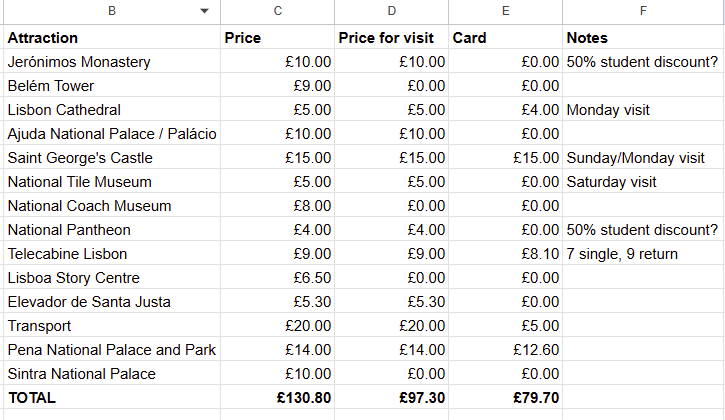
We use a simple planning table with a row for each visit, the separate-ticket price and the amount still payable with the card. The Lisbon example above comes from our own travel plan.
We include discounted admission, attractions outside the pass and any transport costs that remain. Then we add the card price.
Cost without a pass − (pass price + everything still payable) = projected saving
We would also compare different pass durations, or a shorter pass covering a cluster of visits with separate tickets for the rest of the trip.
5. Check Whether the Itinerary Works in Real Life

Once the numbers look promising, we check the time. Can we comfortably visit those places during the validity period? Are they open on our dates? Are there suitable reservation slots? Have we allowed time for travelling between them and actually enjoying each visit?
A pass can be valid for calendar days, a continuous number of hours or another defined period. Check what activates it and when it expires before using it for the first time, including for a transport journey. A three-day stay does not necessarily require a 72-hour card: our Budapest example below shows how the timing of a 48-hour card worked for us.
Budapest: How a 48-Hour Card Worked for Our Three-Day Visit

For our April 2025 visit, we compared the 48-hour and 72-hour Budapest Cards and chose the shorter option. Activating it at 6pm on day one covered public transport that evening and sightseeing over the next two days, until 6pm on day three. Timing it this way saved us paying for the longer card.
We also bought through GetYourGuide with a 10% discount available at the time. Alongside transport, the card covered several museums, a Danube cruise and a pálinka and wine tasting. Our Budapest travel guide has the full breakdown.
The discount at Széchenyi Thermal Baths added value, although we could only claim it by buying tickets in person and queuing. For us, the card worked well, but it showed why checking both the validity window and how discounts are redeemed matters.
Lisbon: A City Card That Also Helped With Our Sintra Day Trip

The Lisbon Card worked well for us because its benefits extended beyond Lisbon itself.
Alongside the attractions and public transport we used in the city, the train journey to Sintra was included. We also received a 10% discount on our visit to Pena Palace. Together, those benefits added to the value we were already getting from the card in Lisbon.
Osaka: When a Pass Encouraged Us to Try Something Different

The Osaka Amazing Pass included plenty of activities for a reasonable price and encouraged us to explore more of the city.
A highlight was Tsūtenkaku Tower, where I tried the slide – something I would not have paid for separately. Having it included made it an easy decision to give it a go.
We would distinguish these extra experiences from savings on visits already planned, but they still added value to our trip. In Osaka, the pass gave us room to be curious and try things we might otherwise have missed. Our Osaka travel guide covers the places we explored.
Graz: When Convenience Was Part of the Value

For our April 2026 visit, the Graz Card combined public transport, selected museum entries, the Schlossberg lift and funicular, and a guided walking tour. Having these covered meant fewer decisions about individual tickets and whether to take the tram.
It still helps to compare the alternatives. At the listed 2026 prices, a 48-hour full Graz Card cost €42 per adult, compared with €26 for a 48-hour Joanneum museum ticket. That left €16 per person for transport and other benefits to justify, rather than counting each museum admission separately. Graz Card Light is another option if you do not need public transport.
For us, the convenience was part of the value: we could spend less time thinking about tickets and more time enjoying the city. Our Graz travel guide covers the places we explored.
Dubai: Why We Booked Separate Tickets

We visited Dubai in November 2023 as two adults. Before travelling, we compared several passes, including options that bundled three, five or seven activities over a set period such as the Dubai Flexi Pass, Dubai Highlights Pass and Dubai Unlimited Attractions & Sightseeing Pass.
None suited the time we had in Dubai and the attractions we wanted to visit. Instead, we bought tickets separately through different websites, including Klook, GetYourGuide and Viator, depending on the offers available.
The clearest saving was a boat trip with dinner. Our planning sheet listed the same experience at £40.18 per person through the official website and £18.85 through Klook – a difference of £42.66 for the two of us.
The experience itself was mixed: we enjoyed the cruise, but the dinner was poor, and I was ill afterwards with what I believed was food poisoning. Finding a cheaper ticket did not make every part of the evening enjoyable.
For our itinerary, separate tickets made more sense. Someone choosing different attractions might find a pass better value, which is why we start with our own list. Our Dubai travel guide covers the places we visited.
New York: Why the Attraction List Mattered More Than Its Length

We took a similar approach in New York, where we considered the New York CityPASS and NYC Explorer Pass.
For the places we wanted to visit, the options we checked did not make sense. Some of the included attractions were not on our list, while discounted individual tickets made booking separately more appealing for our chosen visits.
We ended up using GetYourGuide and Viator to book experiences including the Empire State Building and a Statue of Liberty boat trip.
A pass advertising access to a large number of attractions does not particularly tempt us on its own. We look at how many of those places interest us, whether we have time for them and what we would otherwise pay to visit.
That still leaves room for trying something unexpected, as we did in Osaka. But we would not add attractions to our plans simply to make a pass look like better value. We want the card to fit the trip we are looking forward to.
Pros of City Passes: Savings, Transport and Convenience

They Can Reduce the Cost of Visits Already on Your List
This is the clearest advantage. When several places you want to visit are included, the combined saving can be substantial.
The key is that those visits should suit the trip without adding stops purely to justify the card.
Included Transport Can Make the Day Easier
Having suitable transport included removes some small decisions: whether to walk back when we are tired, take a tram to another neighbourhood or make a short journey across the city.
Our April 2026 Graz visit was a good example. Having suitable transport and attraction benefits together reduced the number of ticket decisions we had to make, as we describe in the Graz case study above.
They Can Make Room for an Unexpected Stop
If admission is already covered and there is time, it can be easier to try a smaller museum or an unfamiliar attraction.
Osaka showed us how much this can add to a trip: having activities included encouraged us to try things we would otherwise have skipped, including the slide at Tsūtenkaku Tower. We would keep that extra enjoyment separate from the savings on our original plans, while recognising it as part of the pass’s value.
Cons of City Cards: Limits, Queues and Rushed Sightseeing

You Pay Before Knowing How Much You Will Use
A change of plan, a closure or simply wanting a slower afternoon can reduce the value. With separate tickets, you may be able to leave more decisions until later, depending on availability and booking terms.
You Can Feel Pressure to Fit More In
There is a difference between enjoying a full day and keeping an eye on the clock because the card expires tomorrow.
We want enough time for the visits themselves, as well as lunch, a walk and the occasional unplanned pause.
Do City Passes Include Skip-the-Line Entry?
Skip-the-line entry is a benefit we would check for each attraction, rather than assume it comes with every pass. A fast-track option may refer to the ticket-buying queue; admission queues, security checks and capacity limits can still apply. You may also need a reservation or ticket exchange. At Széchenyi in April 2025, claiming our card discount meant buying in person rather than booking discounted tickets ahead of time.
Our Lisbon guide describes our experience at Jerónimos Monastery, where having the card did not remove the entry queue. That is a useful lesson from our visit, rather than a promise about how the arrangements work today.
We also missed the included castle-moat boat ride in Osaka because all the remaining slots had filled up. A benefit can be included in the pass and still be unavailable when you arrive.
Check the attraction’s current instructions for pass holders before building the day’s schedule around it.
Some Headline Attractions May Be Excluded or Only Discounted
Check the individual attraction entry, including any special exhibitions, premium time slots, tours or upgrades you want.
The length of the included-attractions list matters much less than whether it covers your priorities. Our New York comparison was a good example: some included options were not on our list, and separate discounted tickets worked better for the visits we chose.
Our Checklist Before Buying a City Pass

Before committing, we would check:
- The exact pass name, version, duration and final price.
- Whether our priority attractions and preferred ticket types are included.
- The total cost of suitable separate tickets, including available offers.
- Remaining admission charges, supplements and booking fees with the pass.
- Transport coverage and what we would otherwise spend on those journeys.
- Activation rules, expiry and any one-visit limits.
- Opening days, reservation requirements and availability.
- Whether the pass still makes sense if we skip one planned visit.
For couples or families, it is worth doing the calculation for each person. Different admission prices, concessions and interests can change which option works.
Final Thoughts
Our experiences with city cards have often been positive, but Dubai and New York reminded us to keep doing the comparison each time.
We would start with the trip we want: the places we are curious about, the journeys between them and enough room to enjoy being there. Then we would see whether a pass supports those plans at a sensible price.
In Budapest, the transport and discount at Széchenyi helped the card fit our visit. In Lisbon, the benefits also stretched to our day trip to Sintra. In Dubai and New York, separate tickets suited us better.
Osaka added another consideration: some of the value came from things we had not planned to try. Hristina’s slide down Tsūtenkaku Tower would never have appeared in our original sightseeing budget, but it is one of the moments that stayed with us.
If you’re ready to start booking, these links cover the essentials — from hotels and tours to insurance and eSIMs.
We send the occasional email with fresh destinations, hotel picks and practical tips we actually use.
- New destination guides and itineraries
- Hotel recommendations (the ones we’d book again)
- Useful travel tools and money-saving tips
- No spam — unsubscribe any time